

In 1972, the idea of buying a machine solely to play games on a household television was unfamiliar enough to require explanation. Televisions received programmes; they did not normally respond to the people sitting in front of them. The Magnavox Odyssey changed that relationship. Its moving blocks of light were extremely simple, but they could be directed by two players, transformed by transparent screen overlays and combined with cards, dice and tokens to create a surprising range of experiences.
Odyssey did not arrive from nowhere. Ralph Baer and his colleagues at Sanders Associates had spent years exploring how an ordinary television could become a play space. Their work produced the Brown Box prototype, a light-gun experiment and the technology Magnavox licensed for its commercial console. Atari then approached electronic table tennis from another direction. Its 1972 Pong arcade machine made the contest immediate: the circuitry kept score, served the ball, produced sound and handled rebounds. Home Pong brought that more automated style of play into American living rooms in 1975.
What followed was a remarkably fast expansion. Dedicated game chips allowed manufacturers to place most of a ball-and-paddle game inside a single integrated circuit. Coleco, Magnavox, Binatone and scores of other brands could now produce television games without designing every function from discrete components. Similar machines appeared in North America, Britain, continental Europe and Japan, often sharing their internal technology while wearing completely different cases and names.
This is the story of gaming’s first console generation: not a neat procession of underpowered computers, but a period when the game was largely the hardware itself. Understanding that distinction explains why an Odyssey selector card is not a software cartridge, why a box could advertise several “games” without containing a game library, and why the arrival of programmable systems such as the Fairchild Channel F represented such a fundamental break.
What counts as the first generation?
The label is a historical convenience rather than a boundary manufacturers recognised at the time. It usually describes dedicated home systems of the early and mid-1970s whose play was created by fixed electronic logic. Those machines overlapped with programmable cartridge consoles after 1976, so there is no single date on which the generation suddenly ended.
The First Generation At A Glance
The period becomes easier to understand when its major systems are compared by what happened inside them, rather than by how many games appeared on the packaging.
| System | First release | How play was produced | Controls & presentation | Why it matters |
|---|---|---|---|---|
| Magnavox Odyssey | United States, 1972; Britain, 1973 | Discrete electronic circuitry reconfigured by selector cards; no CPU, programme ROM or downloadable software | Two three-dial controllers, monochrome shapes, screen overlays and physical game materials; no electronic sound or automatic score | First commercially released home video-game console |
| Atari Home Pong / Sears Tele-Games Pong | United States, 1975 | Fixed-function custom integrated circuit | Built-in paddle controls, on-screen score, sound and automated ball behaviour | Turned a successful arcade idea into a mass-market home product |
| Epoch TV Tennis Electrotennis | Japan, 1975 | Dedicated ball-and-paddle electronics | Two controllers and a wireless UHF connection to the television | Generally recognised as Japan’s first commercially released home video-game console |
| Coleco Telstar | North America, 1976 | General Instrument AY-3-8500 dedicated game chip | Built-in dials and selectable tennis, hockey and handball-style modes | A defining example of the affordable single-chip Pong boom |
| Nintendo Color TV-Game 6 / 15 | Japan, 1977 | Dedicated hardware developed with Mitsubishi Electric | Colour ball-and-paddle variations with controls built into or connected to the console | Nintendo’s entry into the home video-game hardware market |
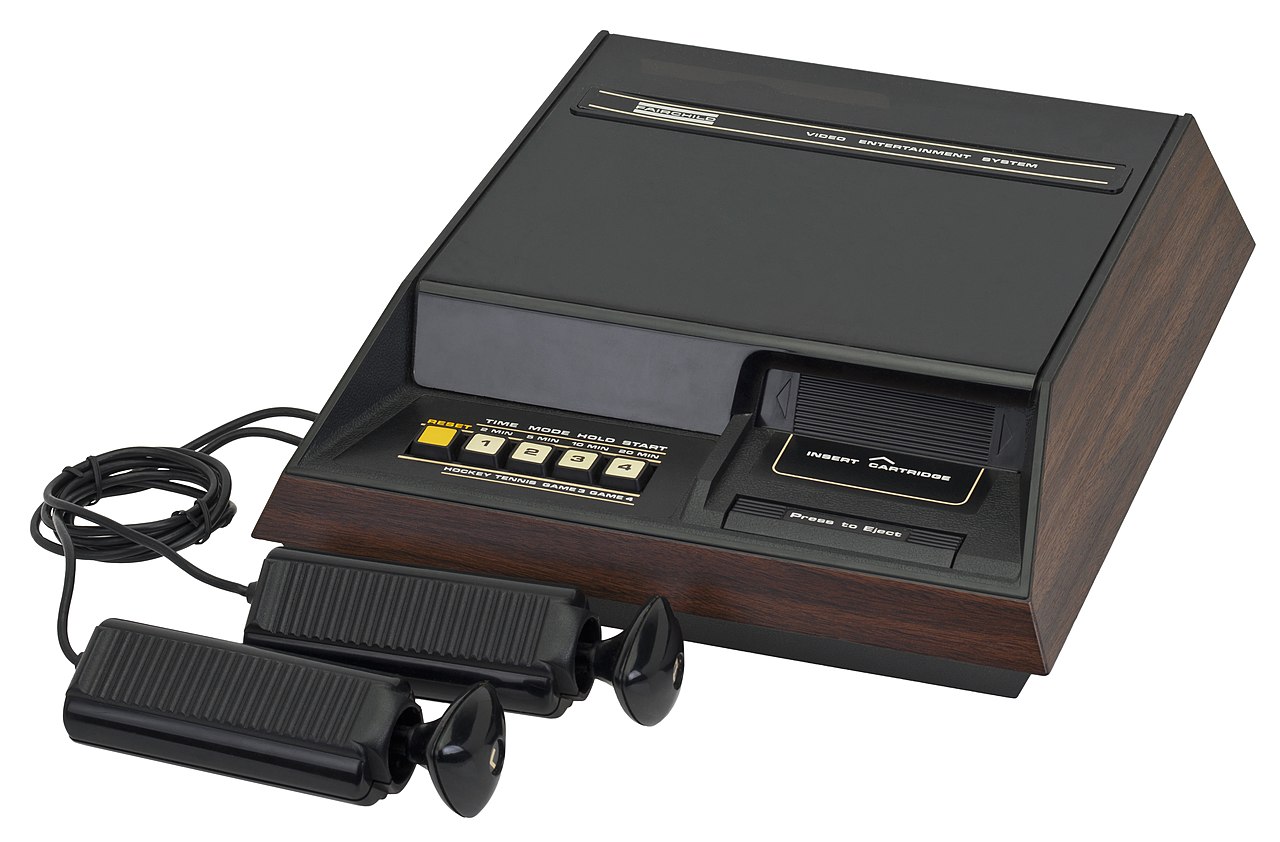
| Fairchild Video Entertainment System / Channel F | United States, 1976 | Microprocessor-based console running programmes stored in interchangeable ROM cartridges | Hand controllers with multiple movements; games could change without replacing the console | The crucial transition into the programmable second generation |
A first-generation machine was normally a dedicated appliance. Its designers chose a limited group of behaviours before manufacture, and those behaviours remained part of the circuitry for the life of the console. Switches could alter speed, bat size, angles or the number of objects on screen, but they did not load a new programme in the modern sense.
This is why the generation can look both simple and confusing. One machine may offer a single clear game, while another advertises ten or fifteen. The latter figure often counts different rule settings or combinations of the same electronic elements. It is more useful to think in terms of modes and variations than a library of separately authored software.
Before The Home Console
Electronic games existed before anyone could buy a console. Experimental projects such as Tennis for Two and Spacewar! demonstrated interactive play on specialised equipment, while Nolan Bushnell and Ted Dabney’s Computer Space reached arcades in 1971. These were essential steps in video-game history, but none was a consumer box designed to connect to a family television.
Ralph Baer had been thinking about that specific possibility since the 1960s. While working at the defence contractor Sanders Associates, he wrote a proposal in 1966 for using a television receiver to play games. With engineers Bill Harrison and Bill Rusch, Baer developed a succession of test units that produced and controlled simple spots on a screen. The team experimented with pursuit games, electronic table tennis and a light gun that reacted when it was pointed at a bright target.
The most complete prototype was TV Game Unit #7, better known as the Brown Box because its aluminium case was covered in wood-effect vinyl. Built during 1967 and 1968, it used switches to configure different activities and came with two controllers. Printed cards told the user how the switches should be set for each game. It was a prototype intended to persuade television manufacturers that interactive entertainment could become a commercial product.

Sanders did not plan to become a toy company. It needed a licensee able to manufacture, distribute and explain the device. After demonstrations to several potential partners, Magnavox licensed the technology and developed it into Odyssey. The journey from laboratory prototype to retail product mattered as much as the underlying invention: an experimental idea now needed packaging, rules, accessories, advertising and a place in an electronics showroom.
First game or first console?
Different “first” claims answer different questions. Earlier laboratory games and Computer Space came before Odyssey, but Odyssey was the first commercially released system designed for consumers to connect to a home television. Calling it the first home video-game console is therefore more precise than calling it the first video game.
Magnavox Odyssey Turns Television Into Play
Magnavox released Odyssey in the United States in September 1972, with a British launch following in 1973. The American package cost about $100, a significant household purchase, and was initially sold through Magnavox dealers. Consumers had to understand both what the machine was and why they might want one. The familiar language of console generations, launch titles and software libraries did not yet exist.
Odyssey generated a small number of white geometric objects against a black background. It could not draw a tennis court, haunted house, ski slope or roulette table, so translucent plastic overlays supplied those settings. Players attached an overlay to the television screen and treated the electronic spots as a ball, a player, a light or another object according to the rules. The same visual behaviour could therefore support several different themes.
The machine had no CPU, no RAM in the familiar computing sense and no programme ROM containing a game. Its circuitry was built from discrete components. There was no electronic sound, no colour image and no automatic scoring. Players counted points themselves, and many games used the bundled cards, dice, tokens, paper money or score sheets. Odyssey was as much a bridge from tabletop games to electronic play as it was a preview of later consoles.

Selector Cards Were Not Software Cartridges
Odyssey’s removable selector cards are a frequent source of confusion because they resemble later cartridges and Magnavox called them “carts”. They did not store programmes. Inserting one connected particular points inside the machine, changing which parts of the existing circuitry were active. A card was therefore closer to a compact switchboard than a ROM cartridge.
This distinction is not merely technical trivia. A programmable cartridge gives a processor new instructions and data, allowing the same base console to run substantially different software. Odyssey’s cards could only reconfigure behaviour that already existed in the console. Much of the variety came from new rules, overlays and physical pieces interpreted by the players.
Controls Built Around Movement, Not Buttons
Each Odyssey controller used three dials. One moved a player’s spot horizontally, another moved it vertically, and the smaller “English” dial influenced the ball-like spot in suitable games. A reset control returned that object to the screen. The arrangement could create more varied motion than the single-axis paddles that later became associated with Pong, although it was less immediately self-explanatory.
Odyssey also supported an optional light rifle. Its technology was rudimentary by later standards, but the accessory established a lasting console idea: a specialised controller could make the television feel like something other than a flat display. Light guns, steering wheels, dance mats and motion controllers all continued that principle in more sophisticated forms.
Several myths grew around Odyssey. One claimed it would work only with a Magnavox television, something the hardware did not require. Another treated its lack of a digital computer as evidence that it was not truly a video game. Neither survives close inspection. The machine connected to an ordinary compatible television, produced controllable video signals and turned them into structured play. It was simply built according to a different technological model from the software-driven consoles that followed.
Atari Pong Makes Electronic Play Immediate
Odyssey proved that home television games could exist, but Atari’s Pong demonstrated how compelling an electronic game could become when the machine enforced nearly all of the action. Atari assigned engineer Allan Alcorn to create an arcade table-tennis game in 1972. The result used fixed electronic circuitry rather than a microprocessor, yet it automatically generated the playfield, bats, ball, collisions, score and audio feedback.
The prototype was tested at Andy Capp’s Tavern in Sunnyvale, California. The familiar story says the machine stopped accepting coins because the container had filled with quarters. Whatever later mythology accumulated around the event, the test made the commercial message clear: a game that could be understood almost instantly could keep players paying for another round.
Pong succeeded because its apparent simplicity hid careful decisions. The ball did not rebound identically from every part of a bat, so players could influence its angle. The speed increased during a rally. Sound confirmed contacts and scores. There were no rule cards to study and no arithmetic to perform. Two knobs and a score display made the contest legible from across a noisy room.
From Tavern To Living Room
Atari began developing a home version in 1974. A custom integrated circuit consolidated the design so it could be manufactured as a consumer product at a viable cost. Sears agreed to sell the machine under its Tele-Games brand for Christmas 1975, placing an initial order widely reported by the Computer History Museum as 200,000 units.

Home Pong was dedicated to one underlying form of play, but it felt more complete than Odyssey’s table-tennis interpretation. The television showed the score and centre line; the machine served the ball and made the sounds; the controls were fixed to the case and mapped directly to vertical movement. Nothing needed to be assembled around the electronic image.
That difference changed expectations. Odyssey asked families to participate in making the game function as a set of rules and materials. Pong placed more authority inside the circuitry. Both approaches were inventive, but the latter became the model copied most aggressively during the middle of the decade.
Pong On A Chip & The Dedicated-Console Boom
Early designers could reproduce a ball-and-paddle game from many individual components, but doing so required specialist knowledge, board space and careful manufacturing. Dedicated game chips lowered that barrier. By 1976, semiconductor companies were offering integrated circuits that generated the principal video, collision, scoring and sound functions required for a television game.
The most influential was General Instrument’s AY-3-8500 family. A manufacturer could combine the chip with a relatively small supporting circuit, controls, switches, an RF modulator, a case and packaging. The chip offered several ball-and-paddle configurations, usually presented as tennis, football or hockey, squash or practice. Optional circuitry could expose additional shooting modes. It did not run stored software; its built-in logic produced a fixed repertoire of behaviours.

This changed the economics of the industry. A toy company, electronics importer or retailer no longer had to create a game architecture from the ground up. It could buy a proven chip, commission a board and distinguish the result through casing, controls, colour circuitry, accessories and price. One internal design might be sold by several companies in different regions, while one brand might release numerous closely related models.
Coleco Telstar
Coleco’s original Telstar, released in 1976, became one of the best-known AY-3-8500 consoles. It offered three selectable modes and two rotary controls mounted directly on its case. It was straightforward, relatively affordable and arrived when demand for home Pong was rising quickly. Coleco followed it with a long series of variations that added detachable controllers, colour, light-gun play or different cabinets.
The 1977 Telstar Arcade is an especially useful warning against judging old hardware by appearance alone. Its triangular body included a steering wheel and gear lever, a light gun, and paddle controls. Plug-in modules selected groups of dedicated games, but these modules contained additional purpose-built electronics rather than programme ROM in the later cartridge sense. A removable component is not automatically a software cartridge.
When “Fifteen Games” Did Not Mean Fifteen Programmes
Manufacturers needed ways to make closely related consoles appear more generous. Packaging might count changes in bat size, ball speed, obstacle layout or team arrangement as separate games. The claim was not necessarily false according to the product’s own rules, but it does not translate neatly into the modern idea of fifteen independently designed titles.
A better comparison asks what the player could actually change. Did the machine support two or four bats? Could it add a central barrier? Were there several speeds? Did it include a solo practice mode, a shooting game, colour or automatic serving? Those variations mattered to buyers even though they emerged from a shared electronic foundation.
A Global First Generation
The history of first-generation consoles is sometimes reduced to three American names: Magnavox, Atari and Coleco. They were central, but the market rapidly became international. Semiconductor designs, licensed technology, rebranded machines and local manufacturing created overlapping national histories. A console familiar to British players might be almost unknown in the United States, even when its underlying chip produced a similar game.
Japan Before The Famicom
Epoch released TV Tennis Electrotennis in Japan on 12 September 1975. Generally recognised as the country’s first commercially released home console, it drew on licensed Magnavox technology and used a low-power UHF transmitter to send its image to the television. The result avoided a direct signal cable between console and set, although the controllers still connected to the game unit.
Nintendo entered the home electronic-game business with the Color TV-Game 6 and Color TV-Game 15 in 1977. Developed with Mitsubishi Electric, these dedicated colour consoles offered variations of ball-and-paddle play directly in hardware. The larger number in each name described selectable variations, not a set of removable programmes. Color TV-Game 15 also used separate wired controllers, making its layout more flexible than the model with controls built into the main case.

Nintendo continued with Racing 112 in 1978 and Color TV-Game Block Breaker in 1979. Official Nintendo interviews describe a period when developers worked across electronics, play design and physical hardware because the game was inseparable from the machine. Shigeru Miyamoto contributed to the exterior design of Block Breaker, years before Donkey Kong and the Famicom made his name internationally familiar.
Other Japanese companies also participated. Tomy’s TV Fun machines, Bandai’s TV Jack range and Epoch’s later dedicated systems demonstrate that Japanese home gaming had a varied commercial history before the Famicom appeared in 1983. Toshiba’s Visicom and related products also show how untidy the generational boundary became as dedicated systems and early programmable machines coexisted.
Britain & Continental Europe
Odyssey reached Britain in 1973, but many players’ first home game was a later Pong-style machine. Binatone’s TV Master range became particularly visible in the British market, while Videomaster, Grandstand, Hanimex, Philips and numerous importers or retailer brands offered their own systems. Similar hardware might appear under a new name or in a differently coloured case depending on the country and distributor.
Britain’s electronics hobby culture added another route into gaming. Magazines and component suppliers advertised AY-3-8500 chips, printed circuit boards, colour add-ons, light-gun parts and complete kits. A confident hobbyist could build a television game rather than buy a finished console. In that context, the boundary between consumer, engineer and player was unusually porous.
Television standards also shaped regional hardware. North American NTSC and European PAL sets required different timing and colour arrangements, while RF tuning and connectors varied. A superficially identical imported console might therefore be unusable or display incorrectly without conversion. Regional releases were not merely changes to the box and instruction leaflet.
How The Hardware Created The Game
Modern game hardware is general-purpose within a defined platform. A processor executes instructions, memory holds changing state, and software tells the machine what to draw, calculate and play. A typical first-generation console worked differently. Oscillators, counters, gates and other electronic components generated the television signal and the rules embedded within it.
The horizontal and vertical position of a bat might come from timing signals adjusted by a potentiometer. The ball could be another timed pulse. Collision logic detected when those signals coincided and changed direction. A score appeared because counters tracked missed returns and drove a simple display. Sound came from short electronic tones triggered by collisions or points. The image was not normally assembled in a frame buffer and then sent to the television; it was generated in step with the television’s scan.
This helps explain the characteristic look. Rectangles, straight lines and large block digits were not a minimalist art style applied after the technology was chosen. They were shapes the circuitry could generate reliably and economically. Colour was often produced by placing areas of colour behind otherwise simple monochrome objects, rather than by giving every object an independently selected palette.
Automation Was A Feature
It is easy to view electronic scoring and sound as trivial because they became standard. In 1972, they changed who was responsible for maintaining the game. Odyssey expected players to remember rules, record points and interpret a spot as different objects. Pong’s circuitry took over scoring, serving, collisions and feedback, making play faster and easier for an unfamiliar audience to understand.
Neither approach should be dismissed. Odyssey’s mixture of electronics and tabletop materials encouraged imaginative reinterpretation. Pong’s automation created immediacy. Together they established two recurring directions in game design: systems that provide flexible tools and systems that enforce a tightly defined contest.
Why Dedicated Hardware Could Still Feel Varied
Fixed logic did not mean every match was identical. Switches could change speed, angles, bat dimensions or the presence of obstacles. Human opponents created unpredictability, and accessories such as light guns or steering controls changed the physical relationship with the screen. A well-designed dedicated game could be narrow in theme but deep in competition.
The limitation was expansion. Once players had explored everything the circuitry allowed, the manufacturer could not release an entirely new genre on a cheap piece of media. It needed a new console, an electronics module or a far more elaborate add-on. That weakness became increasingly important as shops filled with machines offering small variations on electronic tennis.
Not every first-generation design was electronically identical.
Odyssey’s discrete circuitry, Atari’s custom Home Pong chip and the later AY-3-8500 systems all produced fixed forms of play, but they did so with different architectures. “Dedicated” describes the relationship between the hardware and its limited game repertoire; it does not mean every machine used one standard circuit.
Patents, Clones & Market Saturation
The resemblance between Odyssey’s electronic table tennis and Atari’s Pong became commercially significant. Nolan Bushnell saw an Odyssey demonstration before Pong was released, but Allan Alcorn’s arcade machine was a distinct implementation with its own scoring, sound, collision behaviour and display. The historical connection is real without reducing Pong to a component-for-component copy.
Magnavox and Sanders held important patents around television-game technology and pursued companies they believed infringed them. Atari settled and became a licensee, while later cases and agreements helped Magnavox earn substantial licensing revenue. The disputes shaped the emerging industry and preserved detailed evidence about who saw which demonstrations, how early systems worked and how rapidly competing designs developed.
At the same time, the dedicated-chip boom made imitation easy. Dozens of companies could build machines around similar integrated circuits. Some licensed technology or used standard chips legitimately; others copied casing, presentation or gameplay more directly. The word “clone” can therefore conceal several relationships, from a legal single-chip product offering the same generic sport to a deliberate imitation of a famous brand.
The 1977 Contraction
By 1977, the strength of the dedicated-console model had become its weakness. Low entry barriers encouraged manufacturers to order large quantities of systems offering closely related ball-and-paddle games. American retailers faced too much inventory as demand cooled. Prices were cut, unsold machines were cleared and many companies withdrew from video games.
This event is often labelled the video-game crash of 1977, but that phrase needs qualification. It was primarily a contraction in the crowded North American market for dedicated Pong-style home consoles. Arcade games continued to develop, programmable home systems were arriving, and dedicated machines remained available in other regions. It was not the same type or scale of industry-wide crisis as the better-known North American console crash beginning in 1983.
The problem was not that people had suddenly stopped enjoying electronic games. It was that too many near-substitutable products competed on price while offering limited prospects for future expansion. The market needed a way to sell new experiences without asking every household to buy another complete machine.
The Transition To Programmable Cartridges
The long-term answer was to separate the console from the programme. Fairchild released the Video Entertainment System in 1976, soon renamed Channel F. The base machine used the Fairchild F8 microprocessor, while interchangeable Videocarts contained ROM holding game instructions and data. A new cartridge could make the console behave in genuinely new ways without replacing its principal hardware.
Engineer Jerry Lawson led the Fairchild team responsible for turning that concept into a practical consumer system. His contribution is sometimes compressed into the claim that one person “invented the cartridge”. The fuller history is more interesting: Lawson directed an engineering group that solved the problems of safely inserting removable programme media into a mass-market microprocessor console, building on semiconductor and cartridge ideas already developing in the industry.
Atari’s Video Computer System followed in 1977. Later known as the Atari 2600, it combined a 6507 processor, RIOT chip and Television Interface Adaptor with cartridges that supplied programme ROM. The hardware remained constrained, and programmers had to work closely with the television scan, but the commercial relationship had changed. The console became a platform, and its library could grow for years.
The transition did not happen overnight. Fairchild Channel F appeared while dedicated Pong consoles were still multiplying. Atari sold dedicated machines alongside the VCS. Nintendo continued producing Color TV-Game hardware after programmable systems had reached the market, and inexpensive television games remained attractive to buyers who wanted one simple form of play.
This overlap is why generational dates should be used as guides. Channel F is normally placed in the second generation because of its microprocessor and interchangeable software cartridges, even though it launched in the middle of the first generation’s commercial peak. A generation describes a technical and business model more reliably than a calendar period.
Selector card, electronics module or ROM cartridge?
Odyssey cards connected existing circuits. Telstar Arcade modules added dedicated electronics. Channel F Videocarts stored programmes for a processor. All three were removable, but only the third created the software-cartridge model that defined the next console generation.
Preserving First-Generation Hardware
A cartridge game can often be preserved by reading its ROM and documenting the original hardware. That approach is not enough for many first-generation systems because there may be no programme to extract. The experience lives across the circuit board, switches, analogue components, controllers, television interface, printed rules and physical accessories.
Odyssey preservation needs its overlays, selector cards and tabletop pieces as well as a working console. A Pong machine depends on the timing of its circuitry and the feel of its rotary controls. A light-gun game may require a compatible cathode-ray-tube television because the gun reacts to the way that display scans its image. Modern flat panels, signal converters and emulation can reproduce part of the result without necessarily recreating every interaction.
Regional television standards add another difficulty. A PAL console cannot always be tested on NTSC equipment, and an old RF output may not connect cleanly to a modern television. Capacitors, switches and potentiometers deteriorate. Custom game chips can be hard to replace. Even apparently cosmetic objects such as overlays and packaging may contain essential instructions for making sense of what appears on screen.
Five Misconceptions Worth Leaving Behind
- Odyssey was not the first video game of every kind. It was the first commercially released home console.
- Odyssey’s selector cards were not software cartridges. They changed electrical connections inside the console.
- A first-generation “game count” is not directly comparable with a software library. It often includes variations created from shared circuitry.
- The generation did not end everywhere in 1977. Dedicated and programmable systems overlapped for several years.
- The 1977 market contraction was not a complete collapse of video games. It hit the saturated American dedicated-console sector most directly.
Preserving these machines therefore means preserving a system of play, not just an image or binary file. Museums, collectors, repairers and historians need circuit diagrams, period advertising, oral histories, accessories and compatible display knowledge. The work is closer to conserving an electronic instrument or mechanical game than backing up a modern download.
The Bottom Line
The first console generation established the proposition on which every later home system depended: a television could become an interactive play space controlled by the people sitting in front of it. Ralph Baer, Bill Harrison and Bill Rusch helped turn that possibility into working prototypes. Magnavox transformed their technology into Odyssey, the first commercial home console. Atari then showed how automatic scoring, sound and carefully tuned electronic behaviour could make a simple contest instantly readable.
Dedicated game chips carried that idea around the world. Coleco Telstar, Binatone TV Master, Nintendo Color TV-Game and countless related machines lowered the price of entry and placed electronic games in more homes. Their shared foundations also produced fierce imitation and a market crowded with small variations, exposing the limits of selling a new box for every new experience.
Fairchild Channel F and Atari VCS changed the relationship between hardware and game. Programme ROM moved into interchangeable cartridges, the console became an expandable platform and the second generation began. Yet the older model did not vanish immediately, because dedicated hardware remained inexpensive, approachable and effective at the one thing it had been designed to do.
These machines are not primitive versions of modern consoles so much as the product of a different design logic. The game was a circuit, a controller, a television signal and sometimes a collection of plastic overlays or printed rules. Their images may have been made from little more than lines and rectangles, but those shapes taught an industry—and its audience—that television could answer back.
Research Sources & Further Reading
This reworked article was checked against museum collections, first-hand technical histories, official manufacturer material and academic research. Sources are listed for readers who want to explore the evidence in greater depth.
-
Smithsonian National Museum of American History — The Brown Box, 1967–68
Collection documentation for TV Game Unit #7, its switch-based game selection, controllers, light gun and development at Sanders Associates. -
Smithsonian — The Magnavox Odyssey Predicted The Future Of Video Games
Detailed account of Odyssey’s September 1972 American release, selector cards, overlays, controllers and physical components. -
Computer History Museum — 50 Years Of Fun With Pong
History of Allan Alcorn’s arcade prototype, the Andy Capp’s Tavern test, Home Pong’s custom chip and Atari’s Sears agreement. -
Computer History Museum — Game On
Museum overview of the transition from hard-wired television games to Fairchild Channel F and interchangeable ROM cartridges. -
The Strong National Museum of Play — The Career Of Jerry Lawson
Archive-based history of Lawson’s engineering career and leadership on Fairchild’s cartridge-console project. -
The Strong National Museum of Play — Clones In The Archives
Historical analysis of Odyssey, Pong, console cloning and Magnavox’s legal action. -
The Strong — Japanese Home Video Games Before Nintendo’s Famicom
Museum exhibit covering Epoch, Nintendo, Tomy, Bandai, Toshiba and Japan’s wider pre-Famicom market. -
National Videogame Museum — Magnavox Odyssey
UK museum record documenting the console’s 1972 North American and 1973 British releases. -
Nintendo Iwata Asks — When Developers Did Everything
First-hand discussion of Color TV-Game 6 and 15, Racing 112 and Block Breaker, including how their games were implemented in hardware. -
Nintendo UK — Hardware History
Nintendo’s official chronology of its early dedicated television-game hardware. -
Martin Ernkvist — Creative Destruction & Industry Crashes In The Early Video-Game Industry
Academic research on low entry barriers, dedicated Pong-chip systems, market saturation and the 1977 contraction. -
Wikimedia Commons — General Instrument AY-3-8500
Technical image and licensing record for the dedicated ball-and-paddle integrated circuit shown in this article.