

The first home consoles usually placed a complete electronic game inside the machine. Switches could alter its speed, bat size or rules, but the owner could not turn a Pong console into an adventure, racing game or space shooter. A substantially different experience generally meant buying another box containing another set of dedicated circuits.
The second console generation changed that relationship. A microprocessor remained in the base machine while a removable cartridge supplied programme instructions and game data. The television, controllers and central hardware could be reused; the personality of the system changed whenever a new cartridge was inserted. What had been an electronic appliance became an expandable software platform.
Fairchild brought that model to consumers in 1976 with the Video Entertainment System, soon renamed Channel F. Atari followed with the Video Computer System in 1977. Better known from 1982 as the Atari 2600, it turned the cartridge format into a mass-market business. One household machine could become Combat, Space Invaders, Adventure, Pitfall! or River Raid without any change to its internal circuitry.
That flexibility did not make development easy. Early cartridges were tiny, memory was expensive and the Atari VCS contained only 128 bytes of RAM. Programmers nevertheless learned to construct recognisable worlds from compact rules and carefully timed television signals. Arcade conversions sold consoles, individual developers became visible, and Activision proved that an independent company could publish software for hardware it did not manufacture.
Competition widened the idea of what a console could be. Intellivision offered more structured graphics, detailed sports games and keypad controls. Odyssey² combined cartridges with a keyboard. ColecoVision pursued close arcade conversions, while Vectrex placed a vector monitor inside the machine. Cable and telephone services even experimented with delivering games electronically decades before modern downloads.
The cartridge market also introduced a new kind of risk. Every release required ROM chips, circuit boards, plastic shells, printed packaging and a forecast of future demand. By the early 1980s, too many incompatible systems and too many cartridges were competing for the same North American shelves. Returns, discounting, poor forecasting and home-computer competition helped turn spectacular growth into a severe market contraction.
Console generations are retrospective categories, not exact historical boundaries.
Programmable cartridge systems appeared while dedicated first-generation consoles were still being sold. Likewise, Atari 2600 and other second-generation machines remained commercially active after Nintendo’s Famicom and Sega’s SG-1000 had begun the next hardware cycle. The dates are useful guides, not hard borders.
The Second Generation At A Glance
The generation is defined more reliably by its relationship between hardware and software than by a particular processor width, graphics style or date.
| System | First release | Principal hardware | Distinctive approach | Historical importance |
|---|---|---|---|---|
| Fairchild VES / Channel F | United States, 1976 | Fairchild F8 processor; interchangeable ROM Videocarts | Unusual hand controllers and programmable cartridges | First commercial home console to combine a microprocessor with interchangeable programme ROM cartridges |
| Atari VCS / 2600 | United States, 1977 | MOS 6507, TIA, RIOT and 128 bytes of RAM | Software-driven television display, simple joystick and paddle controls | Popularised the cartridge platform and became the generation’s dominant console |
| Magnavox Odyssey² / Philips Videopac G7000 | North America and Europe, 1978 | Intel 8048 family processor and cartridge software | Built-in alphanumeric keyboard and hybrid board-game ideas | Extended Magnavox’s console line and became a significant European platform under Philips |
| Mattel Intellivision | US test markets, 1979; wider release, 1980 | General Instrument CP1610 processor and specialised display hardware | Control disc, numeric keypad, overlays and detailed sports presentation | Atari’s most prominent early challenger and a major experiment in expansion and network delivery |
| Epoch Cassette Vision | Japan, 1981 | Much of the processing logic placed in the cartridge | Low-cost base unit with game-specific cartridge electronics | Important Japanese success before the Famicom |
| ColecoVision | North America, 1982 | Zilog Z80A, TMS9928A video and 16 KB video RAM | Close arcade conversions, bundled Donkey Kong and expansion modules | Raised expectations for bringing contemporary arcade games home |
| Atari 5200 | United States, 1982 | Architecture derived closely from Atari’s 8-bit computer family | Analogue controllers and improved arcade conversions | Demonstrated the cost of replacing a successful platform without direct cartridge compatibility |
| Vectrex | United States, 1982 | Motorola 6809 and integrated monochrome vector CRT | Self-contained line-based display with plastic colour overlays | One of the most technically distinctive home consoles ever released |
The cartridge is the central development, but it brought several related changes. Games became products that could be created, packaged and promoted independently from the console. A successful title could sell hardware. The installed base of one machine could attract outside publishers, while a strong library made the machine more valuable to consumers. This feedback loop is still at the centre of console competition.
The generation was not defined by “8-bit” hardware. The Atari VCS used an 8-bit 6507, ColecoVision used an 8-bit Z80A and Intellivision used a 16-bit CP1610. They belong together because of their period, programmable software model and market relationships, not because they share one processor width. Intellivision’s CPU does not make it a member of the later 16-bit console era.
Channel F Creates The Cartridge Platform
Fairchild released the Video Entertainment System in November 1976, renaming it Channel F the following year. Earlier consoles had used removable cards or modules, but Channel F established a different commercial arrangement: a microprocessor in the base machine executed programmes stored as ROM inside interchangeable Videocarts. Replacing the cartridge could replace the software itself.
The idea had roots in work by Alpex Computer Corporation, which developed a programmable game prototype before Fairchild turned the concept into a consumer product. At Fairchild, Jerry Lawson led the engineering team responsible for making the cartridge system practical. The group had to consider static electricity, repeated insertion, physical durability, connector reliability and the safety of exposing electronic contacts to ordinary users.
Lawson’s importance deserves precision. He did not single-handedly invent every element of the ROM cartridge, and Fairchild’s console was the product of a team and earlier experimentation. His achievement was leading the engineers who converted the concept into the first commercial microprocessor console with robust interchangeable programme cartridges. That contribution shaped every later cartridge platform.
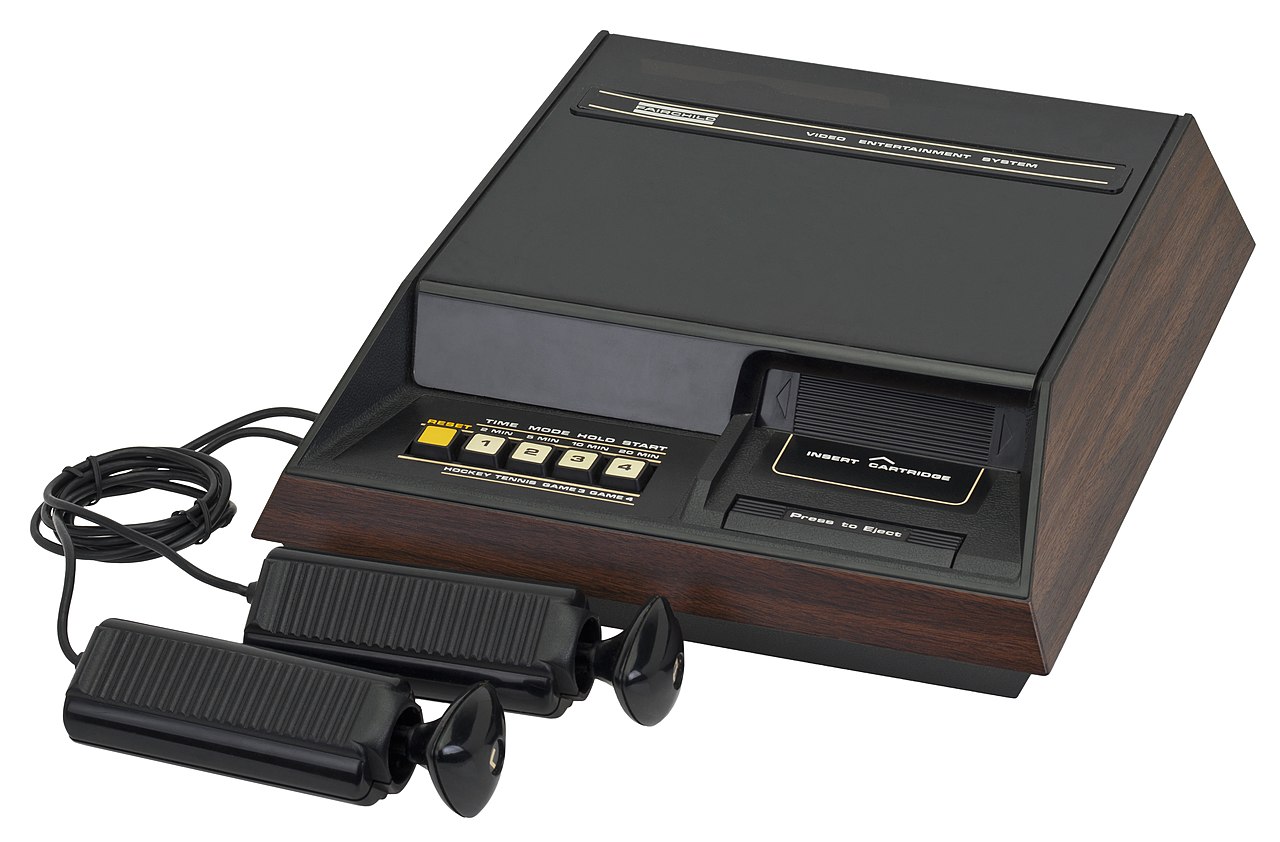
The machine used Fairchild’s F8 processor family and included two built-in games. Its controllers could be pushed, pulled, twisted and moved in several directions, giving software more input possibilities than a simple paddle. The console could also generate colour graphics and play against computer-controlled opponents, helping distinguish it from the fixed two-player television games that preceded it.
Channel F was historically decisive without becoming commercially dominant. Its graphics were coarse, its library remained relatively small and Atari soon attracted greater attention with more action-oriented software. Fairchild sold the system technology to Zircon in 1979. Yet sales leadership is not the only measure of influence: the machine established the hardware-and-cartridge relationship that its more successful competitors developed further.
Why Odyssey’s cards and Channel F’s Videocarts are different.
A Magnavox Odyssey selector card changed electrical connections inside a fixed-logic console. A Channel F Videocart contained programme ROM read by the console’s processor. Both were removable, but only the latter supplied software.
Atari Turns A Platform Into A Mass Market
Atari understood the commercial limits of dedicated hardware because it was already selling home Pong machines. A programmable console promised a longer life: instead of manufacturing a new system for every arcade idea, Atari could release new cartridges for one adaptable base unit. The project was developed under the codename Stella by engineers including Joe Decuir and Jay Miner.
Cost was the central constraint. The machine needed enough flexibility to reproduce several styles of arcade play while remaining affordable for a consumer market. Atari selected the MOS Technology 6507, a lower-cost relative of the 6502, and built much of the system’s distinctive behaviour into the custom Television Interface Adaptor. A RIOT chip provided 128 bytes of RAM, input/output functions and a timer.
Development needed capital. Warner Communications acquired Atari in 1976 and supplied the resources required to complete and manufacture the console. The Video Computer System reached the American market in 1977 with joysticks, paddle controllers and the Combat cartridge. Sears sold a compatible version under its Tele-Games brand.
The launch did not instantly create an empire. Retailers were still clearing dedicated Pong stock, the VCS was relatively expensive and its early software had to teach consumers why buying cartridges was better than buying a machine with several built-in games. Atari’s arcade catalogue and Warner’s marketing power gradually gave the platform momentum.

The system became known formally as Atari 2600 in 1982, when Atari introduced the 5200 and needed clearer product names. By then, “2600” also made sense as a familiar shorthand derived from the original model number. The change can confuse modern histories: Atari VCS and Atari 2600 are the same underlying platform, not separate console generations.
Atari’s greatest advantage was not raw technical superiority. It was the combination of a growing installed base, recognised arcade licences, accessible controls, strong retail distribution and a machine flexible enough for programmers to exceed its designers’ initial expectations. Hardware established the opportunity; software turned it into a culture.
Inside The Atari VCS: Racing The Beam
The Atari VCS did not contain a conventional framebuffer holding a complete screen image. Instead, its Television Interface Adaptor generated the picture in step with the television’s electron beam. The processor had to update playfield, player, missile, ball and colour registers at carefully chosen moments while each frame was being drawn.
This method later became known as “racing the beam”. It gave programmers an unforgiving schedule measured in television scanlines and processor cycles. A routine that took too long could distort the image or upset synchronisation. The same restriction also created flexibility: software could change graphics registers partway down the screen, reusing the limited display objects to produce scenes the original designers had never specified.
The TIA supplied two player objects, two missiles, one ball and a low-resolution playfield, along with colour and audio functions. The 6507 ran the programme, while the RIOT chip’s 128 bytes of RAM held changing game state. That memory had to cover scores, object positions, timers, random values, input state and whatever else the designer needed. By comparison, a short paragraph of plain text can occupy more than 128 bytes.
Early cartridges commonly held 2 KB or 4 KB of ROM. Larger games later used bankswitching: hardware in the cartridge mapped different ROM banks into the same processor address space when the programme accessed particular locations. Some cartridges added RAM or specialised support circuitry. The fixed 1977 console therefore continued gaining effective capability through increasingly inventive cartridges.
Limitations Became Design Material
The VCS’s broad pixels and flickering objects were not simply signs of poor workmanship. They reflected a machine whose small set of display elements had to be reassigned continuously. Programmers decided which objects deserved stable hardware sprites, which could be drawn through playfield tricks and which could flicker on alternate frames. Game design, graphics and timing code became inseparable.
Sound was similarly compact. Two TIA audio channels generated tones and noise patterns rather than sampled recordings. Designers turned them into engines, footsteps, laser fire, warning pulses and short musical phrases. The console’s identity emerged from repeated creative misuse of a small number of electronic behaviours.
The result explains the extraordinary variation between early and late software. The hardware did not become faster and its built-in RAM did not grow, but programmers learned better techniques, cartridge capacities increased and publishers became willing to add supporting electronics. A console designed around simplified versions of 1970s arcade games eventually produced convincing scrolling worlds, speech-like effects and complex simulations.
How Software Began Selling Hardware
The cartridge platform created a new purchasing question. Consumers no longer judged a machine only by the game included in its box; they judged the library it could become. A single desirable release could persuade someone to buy the console required to play it. This is the origin of the “killer application” in home console marketing.
Taito’s Space Invaders had become an international arcade phenomenon after its 1978 release. Atari secured the rights to a VCS adaptation and published it in 1980. The home version did not reproduce the arcade hardware exactly, but it offered numerous variations and delivered the recognisable rhythm of descending formations, defensive bunkers and steadily increasing pressure. Sales of the console rose sharply.
The importance of Space Invaders was commercial as well as creative. It showed that an arcade licence could move hardware and that a console’s value depended on software unavailable elsewhere. Atari’s control of recognised arcade properties gave the VCS a reason to remain relevant even as technically stronger competitors appeared.
Home conversion also became a public test of hardware. Players compared colours, missing objects, sound, movement and control against a version they already knew from an arcade. Perfect reproduction was impossible on inexpensive home systems, so designers had to preserve the identity of a game through selective compromise. The best conversions captured behaviour and tension rather than every visual detail.
Beyond Short Score Attacks
Cartridges soon moved beyond the assumption that home games should imitate brief coin-operated sessions. Warren Robinett’s Adventure turned rooms, objects and dragons into a connected world that could be explored over time. Robinett also hid his name inside a secret room after Atari denied visible author credits, creating one of gaming’s most famous early Easter eggs.
Activision’s Pitfall!, designed by David Crane, presented a jungle spanning 255 screens. Instead of storing each location independently, the cartridge generated their order from a compact mathematical sequence. Carol Shaw’s River Raid used similarly disciplined data and code to create a scrolling river that felt extensive despite the hardware’s tiny memory.
These games did not overcome limitation by pretending it did not exist. Their central ideas were shaped around it. Adventure reused simple objects and room structures; Pitfall! reconstructed a large world from rules; River Raid made a narrow scrolling landscape both technical solution and game design. Constraint produced recognisable forms rather than merely smaller versions of arcade games.
Activision, Named Programmers & Third-Party Publishing
Atari initially treated game creators as anonymous employees. Programmers received salaries, but the company did not normally place their names on boxes or screens, even when a cartridge sold in enormous numbers. As the VCS became more successful, that lack of recognition and reward created growing tension.
In 1979, former Atari programmers David Crane, Larry Kaplan, Alan Miller and Bob Whitehead joined businessman Jim Levy to form Activision. The new company intended to publish cartridges for Atari’s console without being owned by Atari. It was not the first independent game company in every possible sense, but it became the first major independent third-party publisher devoted to producing console software for another company’s hardware.
Atari sued, arguing that outside cartridges threatened its control of the system. The dispute was settled around the end of 1981, with some histories dating the formal resolution to 1982. Activision could continue publishing under a licensing and royalty arrangement. That settlement helped establish the continuing model in which external publishers develop software for a platform owner’s machine.
Activision also marketed its programmers as identifiable creators. Manuals and advertising introduced the people behind the games, while embroidered achievement patches rewarded players who photographed qualifying scores. The cartridge became a product associated with a designer and publisher, not merely another item manufactured by the console maker.
Carol Shaw’s career illustrates the shift. After programming at Atari, she joined Activision and designed River Raid, one of the most technically and commercially notable VCS games. Surviving source listings, design notes and advertising materials now help historians reconstruct her work. Activision did not invent individual authorship, but its marketing made authorship part of the value being sold.
Imagic and many other publishers followed. Competition produced excellent cartridges and broadened the range of ideas available to players. It also reduced the platform owner’s ability to control how many products reached retail. Third-party publishing was not inherently harmful; the later problem was uncontrolled volume, uneven capability and unrealistic manufacturing forecasts.
Activision changed the platform business in two directions.
It proved that outside publishers could create some of a console’s best games, and it showed that the company owning the hardware needed a workable system for licensing, manufacturing quantities and quality expectations. Every later console platform had to balance those interests.
Rival Consoles Expand The Possibilities
Atari led the market, but the second generation was not a one-machine story. Competitors approached graphics, controls, expansion and arcade conversion in very different ways. Their successes and mistakes demonstrate that technical capability alone never guaranteed a sustainable platform.
Intellivision: Sports, Keypads & Expansion
Mattel test-marketed Intellivision in 1979 and introduced it more widely in 1980. Its General Instrument CP1610 was a 16-bit processor, while specialised display hardware created tiled backgrounds and movable objects. Mattel advertised the system through direct side-by-side comparisons with Atari, often using writer and broadcaster George Plimpton to present Intellivision sports games as the more detailed alternative.
The controllers combined a circular directional disc, side buttons and a twelve-key numeric pad. Plastic overlays slid over the keypad so each game could label its controls differently. This offered many inputs for strategy and sports titles, although players often found the controller less immediate than Atari’s single-button joystick.

Mattel promoted an ambitious future of voice, computer expansion and network delivery. Intellivoice added speech synthesis for a small group of compatible cartridges. The promised Keyboard Component suffered repeated delays and became a costly corporate problem before the less ambitious Entertainment Computer System appeared. The episode revealed how marketing an upgrade before it was ready could turn technical ambition into an obligation.
Odyssey² & Philips Videopac
Magnavox returned with Odyssey² in North America during 1978, while Philips sold related hardware in Europe as Videopac G7000. Unlike the original Odyssey, this was a microprocessor console running software cartridges. A built-in alphanumeric keyboard suggested educational and computer-like uses, while several releases continued Magnavox’s interest in combining on-screen action with boards and physical pieces.

The platform was more significant in parts of Europe than a North American ranking alone suggests. Philips branding, regional software and the wider Videopac range gave it a distinct identity. It is a good example of why one global sales hierarchy cannot describe how the generation was experienced in every country.
ColecoVision, Atari 5200 & The Arcade Race
By 1982, consumers had seen far more capable arcade hardware than the VCS was designed to reproduce. ColecoVision answered with a Z80A processor, a Texas Instruments-derived video chip, 16 KB of video RAM and the Donkey Kong arcade conversion bundled with the console. Its visual similarity to the coin-operated hit made an immediate argument for buying new hardware.

Atari responded with the 5200, based closely on the architecture of its 8-bit home computers. It could produce stronger arcade conversions than the 2600 but launched without direct compatibility with the enormous VCS cartridge library. Its non-centring analogue controllers also developed a poor reputation. The machine showed that better specifications could not easily replace years of software, reliable controls and consumer familiarity.
ColecoVision’s own Expansion Module #1 played Atari 2600 cartridges by including what amounted to most of a compatible 2600 hardware implementation. The ColecoVision did not translate VCS software through its Z80 processor. This distinction matters: the module was effectively another console drawing power and output connections from the host.
Vectrex: A Console With Its Own Screen
Vectrex rejected the shared family television entirely. Released by General Consumer Electronics in 1982 and later acquired by Milton Bradley, it contained a built-in monochrome CRT modified to draw sharp vector lines. Plastic overlays added colour and visual framing, while the integrated display gave every owner a consistent presentation.

The design was technically distinctive and avoided the blocky raster graphics associated with its rivals. It was also expensive to manufacture and reached the market just as American console demand deteriorated. Its short commercial life left a small library, but the complete self-contained experience has made it one of the generation’s most recognisable systems.
A Global Generation & Early Game Networks
The second generation looked different depending on where it was played. Atari dominated much of the North American discussion, but European consumers encountered Philips Videopac, Interton VC 4000 and several related Signetics-based cartridge families. Hardware compatibility could be unclear, names varied by distributor and local television standards shaped releases.
Interton’s VC 4000, released in 1978, used a Signetics 2650-family processor and keypad controllers with overlays. Closely related architectures appeared under several European brands without forming one simple worldwide standard. Videopac developed a more coherent identity, while the growing popularity of inexpensive home computers increasingly drew British and European players towards cassette and disk software.
Japan followed another path. Epoch’s Cassette Vision, released in 1981, became a notable domestic success before Nintendo’s Famicom. Its cartridges did far more than store passive ROM: much of the game’s processing logic sat inside the cartridge, leaving the base console responsible for controls, television output and supporting functions. The name “Cassette” referred to the cartridge form, not magnetic tape.
Bally’s programmable console also resists a simple launch date. Announced as the Home Library Computer in 1977, production delays meant customer units did not begin shipping until 1978. It passed through names including Bally Professional Arcade and Bally Computer System before becoming best known as Astrocade. Its Z80-based design and custom graphics hardware were ambitious, but limited retail reach and repeated business changes prevented it from becoming a stable mass-market platform.
Downloads Before The Internet Era
The cartridge was dominant, but a few services explored electronic delivery. PlayCable, developed for Intellivision and deployed through participating cable television operators around 1981, transmitted a rotating selection of games to an adapter attached to the console. The chosen title was loaded into temporary memory, so access depended on the service rather than permanent ownership of a cartridge.
GameLine applied a related idea to Atari 2600 in 1983. Its Master Module included a modem that connected through a telephone line, allowing subscribers to download compatible games for temporary play. The service arrived at a difficult commercial moment and offered only a limited catalogue, but it anticipated user accounts, remote libraries, timed access and software delivered without a shop.
Neither service was a modern digital storefront in miniature. Memory, communication speed, regional infrastructure and licensing severely restricted what it could offer. Their importance lies in the business question they asked: if a console is a programmable platform, does its software need to arrive on permanently owned physical media?
Cartridge Economics & Creative Limits
Programmable cartridges reduced one kind of risk. A failed game no longer required the manufacturer to discard an entire console design. The same hardware could support another release. Yet the cartridge introduced its own financial commitment because software now had to be manufactured as electronics.
A publisher ordered ROM chips, assembled circuit boards, moulded shells, printed labels and manuals, produced boxes and shipped stock before knowing final demand. Larger ROM capacities cost more. Lead times made it difficult to react immediately to changing tastes, and a successful Christmas forecast could look similar to an expensive warehouse problem until consumers made their choice.
Cartridge size did not translate directly into quality. A small programme with a strong central rule could outperform a larger but unfocused release. However, additional ROM allowed more graphics, rooms, behaviours and sound data. Bankswitching and cartridge-added RAM extended what established consoles could do, turning the software medium into a hardware expansion path as well as a container.
Worlds Built From Rules
When storage was scarce, developers avoided recording every detail. Pitfall! used a deterministic sequence to arrange its jungle. River Raid generated a changing landscape from compact information. Entombed built maze passages using a small table-driven algorithm whose exact origins later became difficult even for researchers to reconstruct.
These techniques traded storage for calculation. The cartridge held a rule capable of rebuilding content when needed rather than a complete map of every location. Procedural generation is often associated with enormous modern worlds, but it was equally valuable when an entire game had to fit into a few kilobytes.
Packaging Completed The Picture
Console graphics could show a tank, dragon or explorer only in simplified form. Box art and manuals supplied the detail that the television could not. Atari’s illustrated packages turned abstract screen objects into spacecraft, haunted houses and heroic battles, while instructions explained goals that the programme had little room to display.
This was not merely decoration. Packaging helped players interpret the world and taught them how to use increasingly complicated controls. Intellivision keypad overlays and Vectrex screen overlays made physical printed material part of the interface. Losing those pieces can remove information necessary to understand the original experience.
Why The North American Market Collapsed
By 1982, the North American console business appeared extraordinarily successful. Atari had created a huge installed base, Intellivision was a recognised competitor and new machines from Coleco and Atari promised better graphics. Independent publishers saw an opportunity to sell cartridges to millions of households without bearing the cost of creating a console.
Growth encouraged overconfidence. Too many publishers entered with too many games, while console manufacturers and retailers forecast demand as though rapid expansion would continue. Shelves filled with products of uneven quality. When weaker games failed to sell, retailers discounted them heavily and returned stock. Cheap clearance cartridges made full-price releases harder to justify, damaging even stronger publishers.
Hardware fragmentation added pressure. Atari 2600, Intellivision, Odyssey², ColecoVision, Atari 5200, Vectrex and other systems required incompatible software. A retailer had to decide how much shelf space and inventory to assign to each. Consumers had to decide which machine would still receive worthwhile games after the purchase.
Home computers intensified the competition. In Britain and much of Europe, machines such as the ZX Spectrum and Commodore 64 offered games, programming and perceived educational value, often with inexpensive cassette software. In North America, the Commodore 64 and Atari’s own computer line complicated the value of a single-purpose console. The computer did not single-handedly destroy the console market, but it offered households another way to spend the same money.
Why E.T. Did Not Cause The Crash
Atari’s E.T. the Extra-Terrestrial became the symbol of the collapse. Howard Scott Warshaw was given roughly five and a half weeks to design the game for the 1982 Christmas season, far less than a normal schedule. Atari made an expensive licence commitment and produced for an ambitious sales target. More than a million copies sold, but not enough to meet expectations, and customer returns added to the loss.
The game was therefore a genuine commercial problem, not an invented myth. What it did not do was create the entire market collapse by itself. Oversupply, unrealistic orders, discounting, weak quality control, hardware competition and changing consumer demand were already affecting many companies and products. E.T. concentrated those failures into one memorable cartridge.
Atari did bury surplus products in a landfill at Alamogordo, New Mexico, in 1983. The 2014 excavation recovered E.T. cartridges alongside other Atari stock, confirming the disposal rather than the exaggerated claim that every unsold copy—or every copy manufactured—was buried there. The game remained common because many units had been sold through ordinary retail.
The crash was severe, but it was not worldwide.
The contraction centred on the United States and damaged the wider North American console trade during 1983 and 1984. European home-computer gaming continued, Japanese console development accelerated, and arcades remained active. “The video-game industry disappeared” is an American retail shorthand, not a global description.
Mattel closed its electronics operation, Vectrex production ended, ColecoVision lost momentum and Warner sold Atari’s consumer operations in 1984. High-quality independent publishers were hurt alongside weak ones because retail confidence and distribution had deteriorated. The problem was not simply that too many bad games existed; it was that the commercial system could no longer price, return and replace physical inventory sustainably.
Transition, Preservation & Legacy
Nintendo released the Family Computer and Sega launched SG-1000 in Japan during 1983, while North America’s established console business was contracting. The Famicom preserved the central second-generation idea—a reusable machine running interchangeable cartridge software—but paired it with stronger hardware and a more controlled publishing model.
When Nintendo introduced the Nintendo Entertainment System in North America from 1985, it managed authorised publishers, cartridge manufacture and retail presentation more tightly than Atari had during the boom. This did not mean that one “seal of quality” or one accessory magically revived gaming. Nintendo combined desirable software, careful market testing, controlled supply and a reworked product identity to rebuild retailer and consumer confidence.
The older generation did not stop immediately. Atari continued revising and selling the 2600, and new cartridges appeared for years; the platform was not formally discontinued until 1992. Intellivision hardware and software also continued through corporate changes. A system’s commercial life can overlap multiple historical generations because a large installed base remains valuable long after newer technology appears.
Preserving More Than ROM Files
Second-generation cartridges can often be preserved by reading their ROM, but a faithful record also needs the console, display behaviour, controllers, manuals and physical interfaces. Atari timing tricks depend on how a CRT scans the image. Intellivision games may rely on keypad overlays. Vectrex software expects a vector monitor and frequently a coloured screen overlay.
Original hardware presents practical problems. RF output may not connect cleanly to a modern television, cartridge contacts oxidise, controller membranes fail and ageing capacitors affect stability. Vectrex contains a high-voltage CRT assembly that requires appropriate repair knowledge. Preservation combines digital archiving with electronics, documentation and safe restoration.
Misconceptions Worth Leaving Behind
- Channel F was not simply “invented by one person”. Jerry Lawson led the Fairchild engineering team that turned earlier programmable-game work into a commercial cartridge console.
- Atari VCS and Atari 2600 are not separate systems. Atari adopted the 2600 name formally in 1982.
- Intellivision is not a later-generation console because its CPU is 16-bit. Console generations are not defined by processor width alone.
- Every Atari 2600 cartridge was not limited to 4 KB. Bankswitching and extra cartridge hardware allowed larger programmes.
- Activision did not prove that third-party publishing was harmful. It produced influential games; uncontrolled volume and forecasting were the wider problems.
- E.T. did not single-handedly cause the crash. It became a symbol of failures already spread across the market.
- The crash did not end video games worldwide. Its sharpest effects were centred on North American console retail.
The generation’s lasting contribution is the platform itself. Replaceable software, killer applications, exclusive licences, independent publishers, named developers, downloadable access, cartridge expansion and quality control all emerged as central industry questions. Later consoles changed the media from cartridge to disc and download, but they retained the same relationship between a reusable machine and a library capable of changing its purpose.
The Bottom Line
The second console generation transformed home gaming from a succession of fixed electronic appliances into a software platform business. Fairchild Channel F established the commercial microprocessor-and-ROM-cartridge model. Jerry Lawson’s engineering team made that model practical for consumers, even though Fairchild did not become the market leader.
Atari turned the model into a mass market. The Video Computer System was built around severe cost limits: a 6507 processor, TIA display hardware and just 128 bytes of RAM. Its lack of a framebuffer forced programmers to build the picture as the television drew it. That difficulty became an opportunity for developers who learned to manipulate the machine far beyond the simple arcade conversions originally imagined.
Software created the breakthrough. Space Invaders showed that one cartridge could sell an entire console. Adventure, Pitfall! and River Raid demonstrated exploration, large connected worlds and scrolling action built from very little storage. Activision established third-party console publishing and promoted programmers as visible authors rather than anonymous labour.
Competition broadened the hardware. Intellivision offered detailed sports games and keypad controls. Odyssey² and Videopac combined cartridges with a keyboard. Cassette Vision became a Japanese success through an unusual processor-in-cartridge design. ColecoVision brought contemporary arcade games home with striking accuracy, while Vectrex built a vector display into the console.
The same platform business created new dangers. Every cartridge was both a creative work and a physical manufacturing forecast. When too many publishers and systems competed for limited shelf space, weak demand became unsold electronics, heavy discounting and retailer returns. E.T. embodied Atari’s mistakes, but it did not cause the structural crisis alone.
Nintendo’s later success did not reject the second generation’s invention. It retained interchangeable cartridge software while managing publishers, manufacture and retail presentation more tightly. Every subsequent console has followed the same essential proposition: sell a stable piece of hardware whose value grows through the games that other people build for it.
The second generation therefore left two inseparable lessons. A reusable platform can support extraordinary creative variety, identifiable authors and an industry larger than its hardware maker. It can also fail when software supply, production forecasts and consumer confidence move beyond what the market can sustain.
Research Sources & Further Reading
This reworked article was checked against museum collections, original technical documentation, archive-based histories, first-hand developer material and academic research.
-
Computer History Museum — Let The Games Begin
History of Jerry Lawson, Fairchild Channel F and the commercial interchangeable-cartridge console. -
The Strong National Museum of Play — The Career Of Jerry Lawson
Archive-based account of Lawson’s engineering work, Fairchild and early cartridge development. -
Computer History Museum — Atari’s Roller-Coaster Ride
Collection history covering Atari, the VCS prototype, arcade conversions, the 5200 and the market contraction. -
Atari — Stella Programmer’s Guide
Original technical documentation for VCS display timing, TIA graphics, controls and audio. -
MIT Press — Racing The Beam
Technical and cultural study of Atari VCS programming and its relationship with television timing. -
The Strong — Killer Video Game Applications
Discussion of Space Invaders as a system-selling Atari VCS cartridge. -
The Strong — How Four Programmers Changed The Game Industry
History of Activision’s formation, Atari’s legal response and independent console publishing. -
The Strong — Preserving Carol Shaw’s Trailblazing Career
History and archival documentation of Shaw’s Atari and Activision work, including River Raid. -
Warren Robinett — Adventure For Atari 2600
The designer’s account of Adventure, its development and hidden creator credit. -
John Aycock & Tara Copplestone — Entombed: An Archaeological Examination Of An Atari 2600 Game
Technical reconstruction of Entombed and its compact maze-generation algorithm. -
University of California, Irvine — Intellivision Platform History
Academic overview of Intellivision’s technical, commercial and cultural history. -
Blue Sky Rangers — PlayCable
Specialist documentation for Intellivision’s cable-based game-delivery service. -
Computer History Museum — ColecoVision
Museum history of Coleco’s 1982 console, the Donkey Kong bundle and arcade-conversion strategy. -
Centre for Computing History — Philips Videopac G7000
UK museum record for the European Odyssey² family and its built-in keyboard. -
Centre for Computing History — Epoch Cassette Vision
Technical museum record explaining the Japanese console’s unusual cartridge architecture. -
Centre for Computing History — Vectrex
Museum collection covering the integrated vector CRT, controllers, overlays and cartridges. -
Smithsonian — From Landfill To Museum Collection: E.T. For Atari 2600
Evidence on the game’s short development schedule, sales expectations, Atari’s losses and the Alamogordo burial. -
Martin Ernkvist — Creative Destruction & Industry Crashes In The Early Video-Game Industry
Academic analysis of programmable consoles, independent publishers, home-computer competition and the 1983 crash. -
Nintendo Iwata Asks — Playing Donkey Kong At Home
First-hand discussion of Famicom development and Nintendo’s aim of reproducing its arcade games in the home.